Donald Camp is a picture of creativity

By Jay Nachman
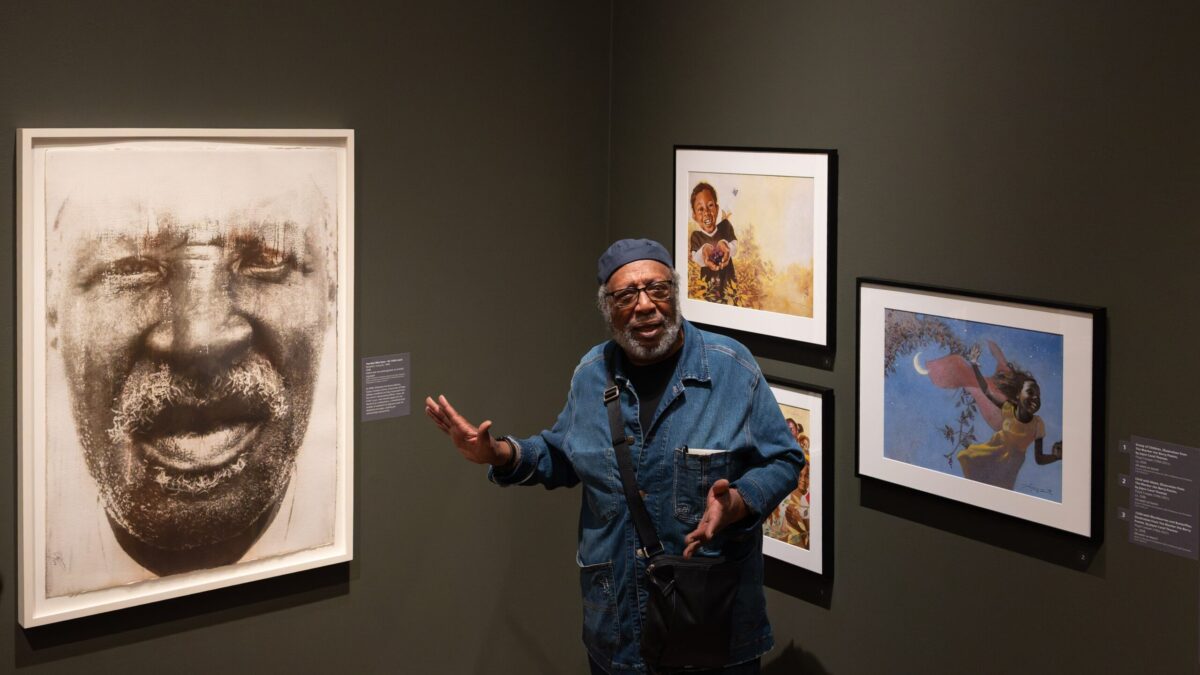
In 1990, local photographer Donald Camp began his ongoing and now signature, photographic series recording the faces of Black men. The series is called “Dust Shaped Hearts.” At the time, he says there were a lot of conversations in the media about the possible extinction of the “Black male as a species.”
This rhetoric really upset Camp. “Since we’re going to disappear, I need to do a method that will prove to people that we once existed,” he says. “We are people who have created the blues, created music that has gone around the world, changed fashion and built America. And there was the lack of existence of Black men, particularly in museums.”
Camp, who is 85, a father of two daughters and grandfather of three, calls his “Dust Shaped Hearts” pictures head shots — not portraits.
“If you become the president of the bank, the newspaper will use a head shot. If you rob a bank, the newspaper will use a head shot. It establishes who you are and what you do. It’s not a thing you put on the piano as decoration.” he says. “It establishes your social position on the planet.”
Camp’s work is featured in museum collections and exhibitions in a number of respected institutions. In 1995, Camp was awarded an Individual Artist Fellowship by the prestigious Pew Center for Arts and Heritage. This honor solidified his reputation among scholars, critics and art patrons. That same year, he garnered awards from the John Simon Guggenheim Foundation and the National Endowment for the Arts.
Camp, now a West Philly resident, was raised in Farrell, western Pennsylvania. The city was a short walk from the Ohio border. He is the youngest of seven brothers and sisters. He moved to Camden, N.J. to complete high school, after being convinced by his brother not to drop out.
After high school, Camp spent 12 years in the U.S. Air Force. He served in Vietnam and other postings with the job of packing parachutes. Camp had been studying photography on his own. So, he decided to cross-train in photography during his ninth year in the service.
At the photo lab, the officer in charge met him with racist remarks. This interaction prompted Camp to change his course of training. However, he continued to study the craft and art of photography on his own.
“It challenged me because I thought it was going to be easy,” Camp says. “But the first prints I made looked terrible. I kept reading and making prints, and it trapped me.”
What attracted Camp to photography was its realism. “I always thought that photography itself was more realistic,” he says. “(It) told the story (better) than painting or sculpture. I was always interested in telling the story.
“I started photography because I thought it was an easier way to get an image. You didn’t have to take all the time to learn how to draw. You just snap and mechanically take a picture. I didn’t realize everything that was involved in making a photograph. You have to learn composition. You have to learn how to see.”
Having built a portfolio, Camp was able to get a job with the Philadelphia Bulletin after leaving the Air Force in 1972. He was the first Black photographer working for a major daily in Philadelphia and the fourth in the country. Camp left the Philadelphia Bulletin after nine years because he felt stifled artistically.
“I was telling someone else’s story, and I wanted to learn how to tell my story,” he says.
He received bachelor’s and master’s degrees from Temple University’s Tyler School of Art. Camp then began his career as a fine artist. This also meant becoming a struggling artist, supported all along by his wife. Camp was hired as an artist-in-residence and assistant professor of photography at Ursinus College in Collegeville, Pennsylvania in 2000. He retired in 2012 as professor emeritus.
Camp says he is getting more recognition now than at any time in his life. And he’s retired enough that he can reject any work that he doesn’t want to do.
He continues to work on the “Dust Shaped Hearts” series. He has created around 150 photographs. The series has grown to include men and women of all races, acknowledging that the struggle against ignorance and intolerance is universal.
“I’m doing it because I live in a world with people who are very, very dark or very, very light,” Camp says. “(We) let other people get fooled into violence and divide us in colors. We’re together in colors. I don’t want to see roses in all one color.”
Jay Nachman is a freelance writer in Philadelphia who tells stories for a variety of clients.