Ben Franklin and Betsy Ross interpreters share their stories

By Jay Nachman
Did Betsy Ross really sew the first American flag?
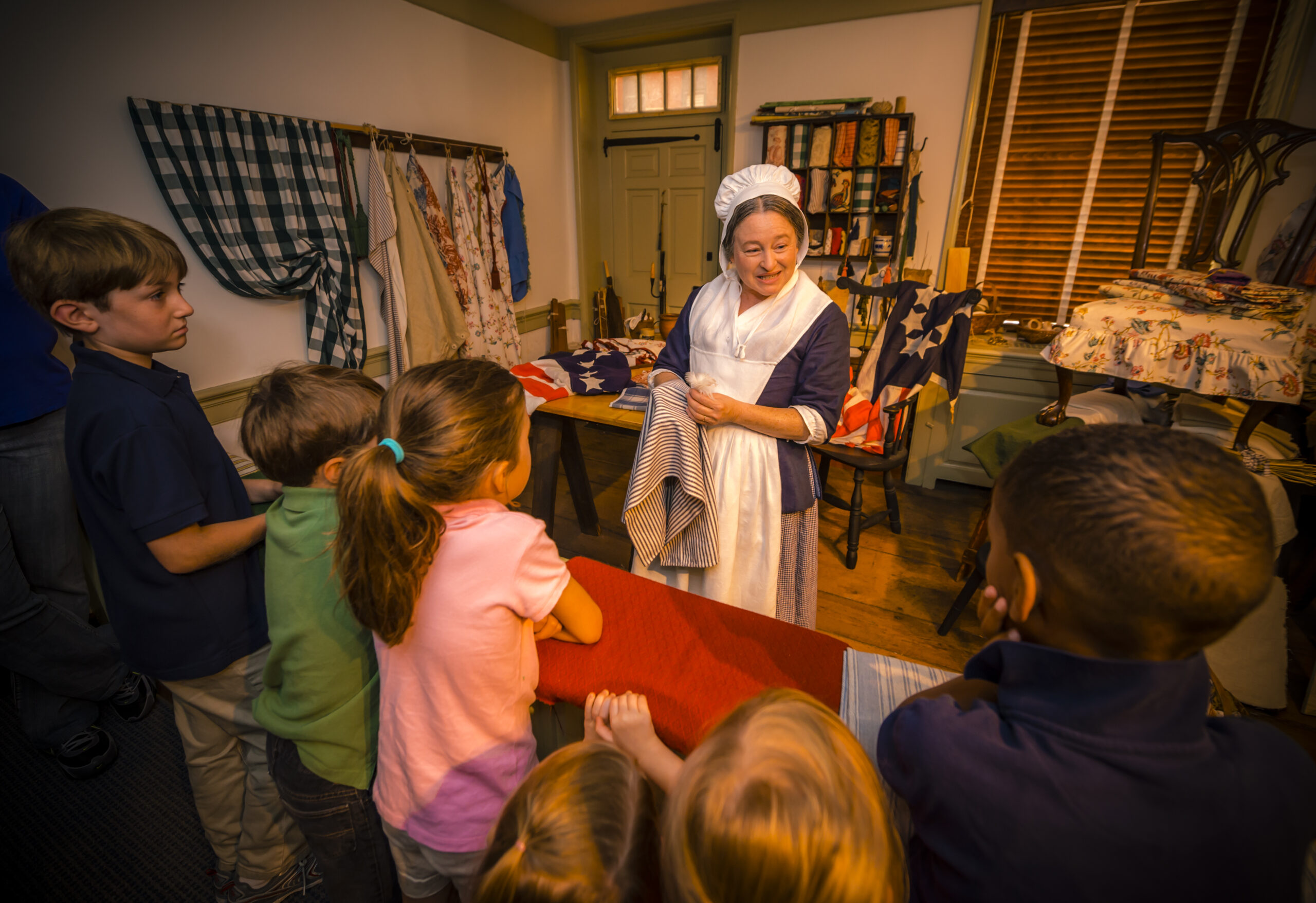
It is possible, according to Carol Spacht, who has been interpreting Betsy Ross at the Betsy Ross House since 2004. The actor, who turns 70 next month, has been portraying Ross for 30 years.
For decades, historians did not believe that Betsy Ross sewed the first American flag. That changed somewhat in 2015, when Mount Vernon discovered something interesting in George Washington’s original ledgers. When Washington was in Philadelphia in the fall of 1774, he dined with noted Philadelphian Benjamin Chew, who was chief justice of the Pennsylvania Supreme Court.
Ross and her husband John worked with Chew. The day after Washington dined with Chew, he visited the Ross’ upholstery shop and ordered bed curtains.
“Does that prove that Betsy Ross made a flag for George Washington?” Spacht asked. “It does not. But it gives credibility to oral history and a family story. Therefore, we will never know. But who knows if another document might show up.”
Betsy Ross interpreters are trained not to say Betsy made the first flag. “As we love to say, ‘It was Betsy’s first flag, more than likely.’ We call ourselves interpreters, and that’s important. Some people are now calling us character historians. We’re interpreting history in a personal way,” Spacht said.
In addition to interpreting Ross, Spacht interprets Martha Washington and others in the region. She is also an accomplished seamstress. Ross sewed curtains and was an upholsterer. “So, she would have done just as I did, making curtains,” Spacht said. “She made curtains for beds. She made curtains for George Washington, documented by Mount Vernon, and it was 2015 when that was discovered.”
When the Betsy Ross House made the decision to reopen the house’s upholstery shop in 2010, Spacht had her needle and thread at the ready. “Everything you see in the Betsy Ross House – and they are beautiful – was sewn by hand in the 18th century manner by all the Betsys over the course of about a decade,” said Spacht, who taught some of the younger interpreters to sew.
Interpreting a Founding Father
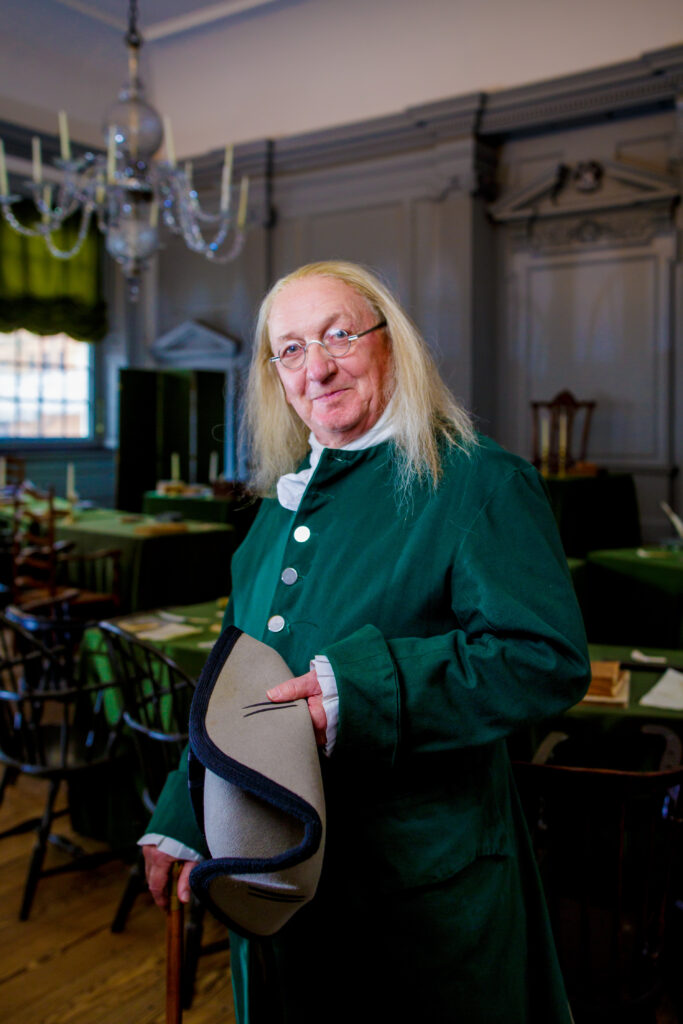
Benjamin Franklin was appointed the first postmaster general for the United Colonies by the Continental Congress on July 26, 1775. But it’s just a coincidence that Bill Robling, 81, worked for the United States Postal Service for 30 years before becoming a Franklin interpreter.
While working, Robling acted and sang. He always had an interest in history being a historical actor. Since retiring in 2002, he has immersed himself in the life of one of Philadelphia’s Founding Fathers. Robling said he has spent thousands of hours studying Franklin, as what had once been an interest evolved into a passion.
“This is one of the most fascinating people in history and not just our history, but in any history,” Robling said. “This is a man with a second-grade education who became one of the most famous people not just in America but in Europe and the world.
Interpreting the iconic Founding Father has taken Robling to several states and twice to the Benjamin Franklin House in London, where Franklin lived from 1757 to 1775 as chief colonial diplomat. “Sometimes you’re an educator, sometimes an actor, sometimes you’re an icon of Philadelphia,” he said.
And, what words of wisdom might Ben have for the readers of Milestones? “Never stop learning. Never stop growing. Keep expanding your mind,” Robling said. “That is one thing Franklin did throughout his life, even to the end. And he lived 84 years. Franklin never stopped.”
Spacht and Robling both work as interpreters for Historic Philadelphia, Inc. The nonprofit organization “makes our nation’s history relevant, real and fun by enlivening historic sites through storytelling, interactions and education,” according to its website. HPI operates the Betsy Ross House, Once Upon A Nation Storytellers and History Makers, and Franklin Square. Once Upon A Nation is presented in partnership with Independence National Historical Park.
The Betsy Ross House, located at 238 Arch St. in Old City, is open daily, March to November, from 10 a.m. to 5 p.m. On Fridays and Saturdays in June and July, it remains open until 6 p.m. For more information, call 215-629-4026 or visit www.HistoricPhiladelphia.org.
Jay Nachman is a freelance writer in Philadelphia who tells stories for a variety of clients.